Predict, Identify, Act: Smarter Care Management

In healthcare, timing is everything. The difference between a patient who gets the right intervention at the right moment and one who ends up in the emergency room often comes down to one thing — whether their care team saw it coming. That’s not a matter of luck or clinical instinct alone. Increasingly, it’s a matter of technology.
As health systems and managed care organizations manage larger, sicker, and more complex populations, the old model of waiting for problems to surface isn’t cutting it anymore. The shift toward proactive, data-driven care has made two capabilities absolutely essential: knowing which patients are at risk before a crisis hits, and having the analytical muscle to act on that knowledge systematically.
The Problem With Reactive Care Management
Traditional care management has always been reactive by design. A patient is discharged after a hospitalization — that’s when care management gets involved. A chronic condition worsens — that’s when a care coordinator steps in. By the time intervention happens, the damage is often already done, and the cost, both human and financial, is already incurred.
The result is a system that spends enormous resources managing avoidable outcomes. Hospital readmissions alone cost the U.S. healthcare system billions of dollars annually. A significant portion of those readmissions are predictable — and preventable — if care teams have the right information early enough to act.
This is exactly the gap that modern care management platforms are designed to close. Not by working harder, but by working smarter — using data to surface risk before it becomes a crisis.
What High-Risk Patient Identification Actually Looks Like
Effective high-risk patient identification software doesn’t rely on a single data point. It pulls from multiple sources — claims data, clinical records, pharmacy fills, lab results, social determinants of health — and combines them into a composite risk picture that’s far more accurate than any single indicator could be on its own.
A patient with diabetes, a recent gap in medication fills, two ER visits in the past six months, and a documented housing instability flag isn’t just a clinical risk. They’re someone who needs a specific kind of support — and soon. High-risk patient identification software makes that person visible to the care team before their next ER visit, not after.
What separates good high-risk patient identification software from a basic risk score is actionability. A number on a screen doesn’t help anyone. What matters is whether the platform tells you who is at risk, why they’re flagged, what interventions are appropriate, and how to reach them — all within a workflow that a care coordinator can realistically act on during a busy day.
Predictive Analytics: From Data to Decisions
This is where predictive analytics for care management comes into play. The term gets used loosely, but at its core, it means using historical and real-time data to forecast future health events — and using those forecasts to drive clinical decisions today.
For a health plan managing 50,000 members, predictive analytics for care management helps answer questions that would otherwise be impossible to address at scale. Which members are most likely to be hospitalized in the next 90 days? Who is showing early signs of disease progression that could be slowed with the right intervention? Which patients are falling through the cracks between primary care and specialty services?
These aren’t hypothetical questions — they’re the exact questions that care management teams are trying to answer every day, often with insufficient tools. Predictive analytics for care management doesn’t replace clinical judgment. It sharpens it. It gives care managers a prioritized, evidence-based view of who needs attention most, so limited resources go where they’ll have the greatest impact.
Turning Predictions Into Action
Prediction without action is just information. The organizations getting the most value from these tools are the ones that have connected their analytics layer directly to their care management workflows — so a risk flag doesn’t sit in a report somewhere, it triggers an outreach task, a care plan update, or a coordination request.
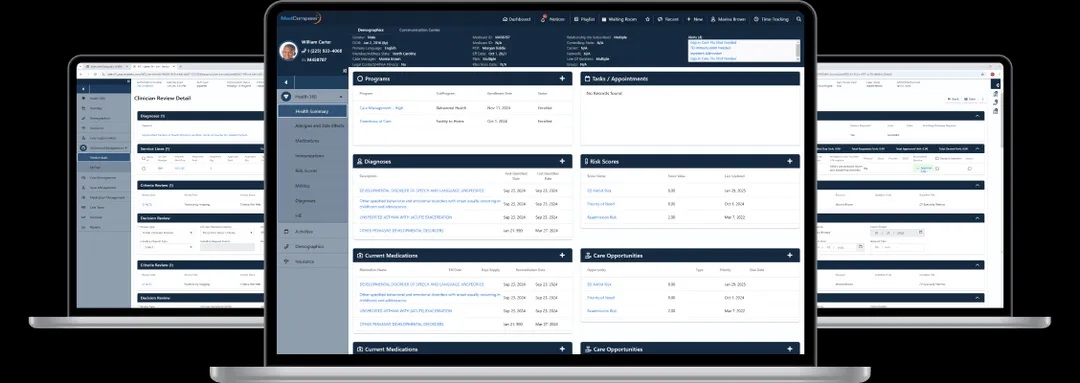
That integration is what makes platforms like AssureCare’s care management solution worth paying attention to. When high-risk patient identification and predictive analytics are embedded within a broader care management platform rather than bolted on as separate tools, the entire workflow becomes more coherent. Risk stratification informs care planning. Care planning informs outreach. Outreach outcomes feed back into the model. Over time, the system gets smarter — and so does the care team using it.
This kind of closed-loop approach is particularly valuable in value-based care arrangements, where organizations are financially accountable for outcomes. When you can demonstrate that proactive identification of high-risk patients led to fewer hospitalizations, lower total cost of care, and better quality scores, that’s not just a clinical win — it’s a business case that’s easy to make.
Getting the Most Out of These Tools
Implementing high-risk patient identification software and predictive analytics for care management isn’t a plug-and-play proposition. Organizations that get it right tend to share a few common practices.
They start with data quality. Predictive models are only as good as the data going in. Incomplete claims data, outdated member records, and missing clinical information all degrade model accuracy. Investing in data hygiene upfront pays off significantly downstream.
They involve frontline staff early. Care coordinators who understand how risk scores are generated are far more likely to trust and act on them. Organizations that treat these tools as a black box often see low adoption rates, regardless of how good the technology is.
They measure outcomes continuously. The goal isn’t to deploy predictive analytics and move on. It’s to track whether interventions are working, refine the approach, and use outcomes data to improve both the model and the care process over time.
The Takeaway
Healthcare organizations that are still managing populations reactively are fighting an uphill battle — and the gap between them and those using predictive tools is only going to widen. High-risk patient identification software and predictive analytics for care management aren’t futuristic concepts anymore. They’re table stakes for any organization serious about delivering better outcomes at lower cost.
The patients who need the most help are already in your data. The question is whether your platform is surfacing them in time to make a difference.
Share this content:










Post Comment